Canned
Answers to Stale Objections
IF YOUR
parish priest says that you cannot attend Mass or receive the sacraments
according to the “received and approved” rites
of the Roman Catholic Church at Ss. Peter & Paul Roman Catholic Mission
because:
·
1) Our bishop does not approve!
Reply:
Why is the
bishop’s “approval” necessary in this case?
Every Catholic without exception is morally obligated on pain of sin to
properly inform his conscience and then obey it. That is exactly what the members of Ss. Peter
& Paul Roman Catholic Mission have done.
The members have presented formal questions of conscience to our local
bishop and to the authorities in Rome on matters of Catholic Faith, Morals and
Liturgical worship regarding their duties to God and their rights derived from
these duties to the “received and approved”
immemorial traditions of our Church.
This was done nearly over
twenty years ago and since then, the petition has been repeated to our local
bishop on numerous occasions as clearly documented on the Mission’s Open
Letters web page. The local bishop and
the authorities in Rome have not addressed these questions. Bishop Kevin Rhoades specifically said, “I
do not intend to submit your request to Rome, nor do I have plans to initiate a
judicial process.” Aside from the fact that this constitutes a
grave and callous dereliction of duty, it also permits freedom of action on the
part of the Mission and its members. As
St. Thomas More said in his dramatic trial, “The maxim is ‘Qui tacet consentiret’: the maxim of
the law is ‘Silence gives consent.’” The
failure of Rome to authoritatively address this matter of conscience that
pertains directly to Catholic Faith and Morals permits the assumption of
approval until the Pope, from the chair of Peter, rules otherwise. Again, it bears repeating, every Catholic, on
the pain of grave sin, is morally obliged to form a true and certain
conscience, and then to follow it.
If our
claims are true, the bishop has a strict obligation to approve and support what
we are doing. If our claims are true, the bishop will have a strict accounting
to make to God for his failure to support Ss. Peter & Paul Roman Catholic
Mission in the defense of Catholic doctrine, morals, and liturgical purity. The
bishops of Harrisburg have made public charges of "heresy" and
"schism" against the Catholics of Ss. Peter & Paul Roman Catholic
Mission but, in spite of our repeated requests, they have failed to bring
formal canonical charges of "heresy" and "schism" against
us. The purpose of a canonical charge of a crime to bring those in error back
to truth. Canonical charges must be supported by evidence and argument. The
diocese has neither. Calumny is a grave sin.
·
2) They are a group in schism from the Catholic
Church!
Reply:
Are
they? Do these people making this charge
even know what the definition of schism?
Then why does the Mission pray for the Pope and the local bishop by name
in the Rosary of Reparation recited daily in their chapel? Why do they pray for the Pope and the local
bishop in every Mass offered in their chapel?
Schism, as an ecclesiastical crime, is defined as failure to hold
communion with the Pope in Rome or with those in communion with him. If it is true that the members of Ss. Peter
& Paul have failed to hold communion with the local bishop and the pope,
why have they formally petitioned for their official judgment regarding
questions of Faith and Morals? Where is
the evidence of the findings of fact and legal judgment determined from a
formal canonical judicial case against them?
The Masses offered at Ss. Peter & Paul Roman Catholic Mission are
open to the public. Since you are
advising Catholics not to attend their Masses, are you refusing “communion”
with them? Who then is guilty of
“schism”?
·
3) They teach doctrines contrary to the Catholic
Church!
Reply:
Do
they? Please document exactly what
Catholic doctrines they do not hold or teach contrary to the Catholic
faith? Also please explain why you, or
anyone else from the local chancery, have failed over the last fifteen
twenty years to document any specific charge of heresy beyond the general
accusation? Why have you failed to meet
their public challenge for an open written exchange on this charge? If what the Mission holds as true, that is,
the immemorial traditions of the Church are the images of our faith which
constitute necessary attributes of the faith by which alone it can be know and
communicated to others, then, are those who have abandoned these traditions
apostates to the faith?
·
4) Their Masses are valid but illicit!
Reply:
This is
another way of saying the “bishop does not approve.” See reply to objection #1. The Mission has provided, as they are morally
obligated to do, a public explanation on a matter of conscience for their
failure to conform with specific canons of the Catholic Church. They have done all that is required of them
canonically and morally to do. Why
hasn’t the local bishop done the same?
Fr. Paul
Kramer et al. explain:
The Tridentine Profession of Faith of Pope Pius IV, Iniunctum Nobis,
prescribes adherence to the “received and approved
rites of the Catholic Church used in the solemn administration of the
sacraments.” The “received and approved rites” are the rites
established by custom, and hence the Council of Trent refers to them as the “received and approved rites of the Catholic Church
customarily used in the solemn administration of the sacraments” (Sess. VII,
can XIII). Adherence to the
customary rites received and approved by the Church is an infallible defined
doctrine: The Council of Florence defined that “priests….
must confect the body of the Lord, each one according to the custom of his
Church” (Decretum pro Graecis),
and therefore the Council of Trent solemnly condemned as heresy the
proposition that “ the received and approved rites of
the Catholic Church customarily used in the solemn administration of the
sacraments may be changed into other new rites by any ecclesiastical pastor
whosoever.”
Fr. Paul
Kramer, The Suicide of Altering the Faith
in the Liturgy
Regarding
these “received and approved” rite, Pope St.
Pius V declared in Quo Primum that:
“…this
missal is hereafter to be followed absolutely, without any scruple of
conscience or fear of incurring any penalty, judgment or censure, and may
freely and lawfully be used… Nor are superiors, administrators, canons,
chaplains, and other secular priests, or religious, of whatever title
designated, obliged to celebrate the Mass otherwise than as enjoined by Us. …
Accordingly, no one whatsoever is permitted to infringe or rashly contravene
this notice of Our permission, statute, ordinance, command, precept, grant,
direction, will, decree and prohibition.
Should any person venture to do so, let him understand he will incur the
wrath of Almighty God and of the Blessed Apostles Peter and Paul.”
Pope St.
Pius V, Papal Bull, QUO PRIMUM, Tridentine Codification of the traditional Roman Rite of
the Mass.
In light of
the above quotation, please explain how a Catholic priest offering and the
faithful attending the immemorial Roman rite of Mass can be made an “illicit”
act?
·
5) Attending their Masses does not fulfill your
Sunday obligation.
Reply:
This
question has already been addressed by authorities in Rome. Their answer has been provided to the local
bishop and his judicial vicar by Ss. Peter & Paul Roman Catholic Mission,
yet, this objection is mindlessly repeated.
Is that because it is useful to bully the uninformed? And what good Catholic would suspect their
local pastors to lie to them? The
following reply was communicated to the local ordinary seven years ago:
Rev. Msgr. Camille Perl, Secretary of the Pontifical Commission of Ecclesia Dei and no friend of Catholic tradition, wrote a private letter on September 27, 2002 that was published in part in the Remnant. Msgr. Perl wrote a follow up public letter on January 18, 2003 that was intended to provide further clarification of the private letter written in September. In the letter of January 20, 2003 Msgr. Perl said:
“In response to the question, Points 1 and 3 in our letter of 27 September 2002 to this correspondent are accurately reported. His first question was "Can I fulfill my Sunday obligation by attending a Pius X Mass" and our response was:
"1. In the strict
sense you may fulfill your Sunday obligation by attending a Mass celebrated by
a priest of the Society of St. Pius X."
Msgr. Perl’s reply is fully in accord with the canons of the Catholic
Church.
Can.
923 The Christian faithful can participate in the eucharistic
sacrifice and receive holy communion in any Catholic rite, without prejudice to
the prescript of can. 844.
Can. 844 §2. Whenever necessity requires it or true spiritual
advantage suggests it, and provided that danger of error or of indifferentism
is avoided, the Christian faithful for whom it is physically or morally
impossible to approach a Catholic minister are permitted to receive the
sacraments of penance, Eucharist, and anointing of the sick from non-Catholic
ministers in whose Churches these sacraments are valid.
Can.
1248 §1. A person who assists at a Mass celebrated anywhere in a Catholic rite
either on the feast day itself or in the evening of the preceding day satisfies
the obligation of participating in the Mass.
· 6) Their
confessions are not valid!
Reply:
And why
not?
Can.
844 §2. Whenever necessity requires it or true spiritual advantage suggests it,
and provided that danger of error or of indifferentism is avoided, the Christian
faithful for whom it is physically or morally impossible to approach a Catholic
minister are permitted to receive the sacraments of penance, Eucharist, and
anointing of the sick from non-Catholic ministers in whose Churches these
sacraments are valid.
It is
the individual Catholic who is authorized to designate the priest for whom the
Church supplies jurisdiction to validly administer the sacrament of penance
because it is the individual Catholic who selects the priest to hear his
confession and determines the criteria that make it “physically
or morally impossible to approach a Catholic minister.” If any Catholic can go to confession to a
non-Catholic priest, a fortiori, he
can do so with any Catholic priest in cases where a “true
spiritual advantage suggests it” because, with a Catholic priest who
follows the “received and approved” immemorial
traditions, there is no “danger of error or of
indifferentism.”
And
what might be the grounds for “moral impossibility”? How many priests in this diocese have informed
the Catholics in their parishes that the use of artificial birth control is a
grave sin? How many priests in this
diocese have informed their parishioners that the Church infallibly teaches
that there is “no salvation outside the Catholic Church”? There are many like examples that can be
provided. Can you offer any serious
objection to Catholics who chooses a confessor that will not lead them or their
children into doctrinal or moral error?
· 7) You
can attend a locally approved Latin Mass instead!
Reply:
The
locally approved Latin Masses are a concession granted firstly as an Indult, and then as a grant of legal privilege under Summorum Pontificum, and
now again as an Indult under Traditionis Custodes. They are not the immemorial “received and
approved” Roman rite of Mass but rather the Extraordinary Form of the Novus Ordo, the Msgr. Anibale Bugnini reform transitional Missal in common usage in
1962. The immemorial traditions of the
Latin rite are not, nor could ever be, the subject of an “indult” which is the
permission to do something forbidden by human law. The question is: Can human law make the
immemorial worship of God illegal? Ss.
Peter & Paul claims that no one possesses the authority to make the worship
of God illegal. They are asking, or
rather demanding, for the Pope to authoritatively declare whether or not he, as
the Pope, possesses the authority to make the immemorial traditions of the
Roman rite illegal and forbid them to the Catholic faithful. Pope Benedict in the past has said that the
pope does not possess such authority:
“After the Second Vatican Council, the
impression arose that the pope really could do anything in liturgical matters,
especially if he were acting on the mandate of an ecumenical council.
Eventually, the idea of the givenness of the liturgy,
the fact that one cannot do with it what one will, faded from the public
consciousness of the West. In fact, the First Vatican Council had in no way
defined the pope as an absolute monarch. On the
contrary, it presented him as the guarantor of obedience to the revealed Word.
The pope's authority is bound to the Tradition of faith, and that also applies
to the liturgy. It is not "manufactured" by the authorities. Even the
pope can only be a humble servant of its lawful development and abiding
integrity and identity. . . . The authority of the pope is not unlimited; it is
at the service of Sacred Tradition.”
Joseph Cardinal Ratzinger,
Spirit of the Liturgy
Another
problem with the Extraordinary Form of the Novus Ordo,
the 1962 Missal, is that it is only exercised as a grant of legal privilege
which can be revoked by the free and independent will of the legislator (as was
recently done by Pope Francis, Traditionis Custodes).
Permission has been granted in this diocese on the condition of silence
to sin. Our former ordinary, Bishop
Kevin Rhoades, gave the cathedral Church, St. Patrick, to the Lutherans for the
installation ceremony of their “bishop.”
This grave sacrilege was met by mute silence by the indult crowd lest
they should lose their favor. He also
vetted the sermons at the Indult Masses for conformity with the new orthodoxy
and censored priests that did not conform.
When he told a public gathering of Jews that the ‘Church did not seek
their conversion to the Catholic faith,’ again there was not a word of
objection raised by the Indult community.
Ss. Peter & Paul Roman Catholic Mission affirms that the right of Catholics
to worship God according to the immemorial traditions of our Church cannot be
conditionally exercised at the price of
accommodating doctrinal or moral error.
· 8) They are dangerous!
Reply:
This
of course is true. The truth is always
“dangerous.” Once exposed to the truth things are never the same. If you turn away from truth, you turn away
from God.
In
fine, Ss. Peter & Paul Roman Catholic Mission claims that Catholics, by
virtue of their baptismal character, have a duty imposed by God to profess
their Catholic Faith and worship God in both the internal and external
forum. They claim that this duty,
imposed by God, to publically profess their faith creates a right to the
immemorial traditions of the Church which are the perfect and necessary outward
expression of the internal faith that they must unconditionally hold if they
are to save their souls. They further
claim that this right cannot be conditionally exercised at the price of
compromising Catholic Faith or Morals.
They are awaiting Pope Benedict’s Francis’ authoritative judgment
on this claim and they expect their local ordinary, as a matter of grave duty
imposed by his office, to do his part to expedite this matter with Pope Benedict
XVI Francis.
·
9)
You do not
have a priest. Your priest has been
laicized and is no longer a priest.
Reply:
It may be
true that in the Novus Ordo Church a Novus Ordo priest can "take the honour to himself" (Heb. 5:4) whenever he
likes, be hired at will or fired whenever he is no longer considered useful for
the ends for which the Novus Ordo Church has been
constituted, but this is not true in the Catholic Church.
In the
Catholic Church a priest is ordained to offer the holy sacrifice of the Mass
and administer the sacraments. His
calling is from God and he "is made not according to the law of a carnal
commandment, but according to the power of an indissoluble life: For he testifieth: Thou art a priest for ever,
according to the order of Melchisedech.... But this with an oath, by him that said unto
him: The Lord hath sworn, and he will not repent, Thou art a priest for ever..... for
that he continueth for ever, (and) hath an
everlasting priesthood."(Heb 7: 16-17, 21, 24)
In the
Catholic Church the indelible character imprinted upon the soul of a man
ordained to the Catholic priesthood can never be effaced. Furthermore, no Catholic priest can be permanently suspended from his
priestly duties without just cause and canonical due process which
necessarily requires a criminal charge that must be proven in the external
forum. No priest can simply be
administratively laicized against his will. Our priest, Fr. Samuel Waters, was laicized
from the Novus Ordo Church and this was done without
any formal charge of a crime and without a canonical hearing. The only "charge" made against our
priest was from the Archdiocese of Philadelphia
for the "crime" of "schism" because, as specifically
cited in a formal letter from Archbishop Chaput, he
offered the immemorial Roman rite of Mass (and not the 1962 Bugnini
transitional Indult Missal). As St. Pius
V said regarding the Missal used at our Mission:
“…this
missal is hereafter to be followed absolutely, without any scruple of
conscience or fear of incurring any penalty, judgment or censure, and may
freely and lawfully be used… Nor are superiors, administrators, canons,
chaplains, and other secular priests, or religious, of whatever title
designated, obliged to celebrate the Mass otherwise than as enjoined by Us. … Accordingly,
no one whatsoever is permitted to infringe or rashly contravene this notice of Our permission, statute, ordinance, command, precept,
grant, direction, will, decree and prohibition.
Should any person venture to do so, let him understand he will incur
the wrath of Almighty God and of the Blessed Apostles Peter and Paul.”
Pope St. Pius V, Papal Bull, QUO PRIMUM, codification of the
"received and approved" immemorial Roman rite of Mass
Let
everyone be clear about this matter. The only way a priest can be laicized administratively against his will
is when there is an administrative declaration that his ordination was invalid.
Therefore, the Novus Ordo administrative declaration
of laicization of Fr. Waters is an indirect declaration of the invalidity of
his Novus Ordo rite of Ordination by John Cardinal Krol, the former Archbishop of Philadelphia.
On
exactly what grounds the Novus Ordo sect has
determined that the ordination of Fr. Waters by Cardinal Krol
was invalid has not been shared with him or with anyone else as far as we know,
but this act of administrative laicization calls into question all Novus Ordo ordinations.
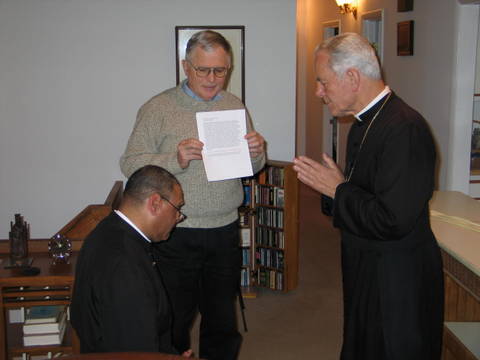
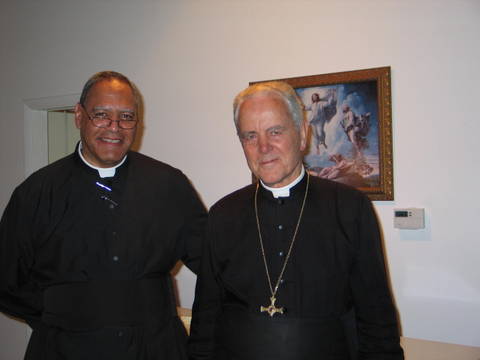
But
rest assured, Fr. Waters is no longer just a "Novus Ordo"
priest. Because of the unjust action of
Bishop Chaput that cast public doubt upon the
validity of Fr. Waters ordination, Fr. Waters was ordained conditionally in
2014 according to the "received and approved rites
·
10) This Mission was offered an opportunity to turn their property
over to the diocese and become an Indult community. Please explain why the Mission rejected the
offer of becoming a diocesan Indult community?
Reply:
An Indult
community such as the Mater Dei
community in Harrisburg is granted the privilege Indult by the ordinary
of receiving the sacraments according to the “Extra-ordinary form.” This grant of privilege Indult is
entirely up to the arbitrary dictate of the ordinary. The FSSP receives this privilege
Indult subject to specific conditions, such as:
A.
They must accept the principle
that Vatican II is free from all doctrinal error.
B.
They must accept in principle
that the Novus Ordo rites are free from all error.
C.
They must accept in principle
that the pope is the proximate rule of faith (and not dogma).
D.
They must accept the
Neo-modernist principle that the truth of any dogma is distinct from its
grammatical formulation which is open to constant development and refinement
from human accretions.
E.
They must accept in principle the
existence of mere ecclesiastical faith, that is, infallible objects of faith
that are not revealed by God and are subject to modification or abrogation by
ecclesiastical authority.
F.
They must accept in principle the
belief that the ecclesiastical traditions that make the faith known and
communicable to others are simply and merely accidental matters of
ecclesiastical faith.
G.
They must accept that the liturgy
is merely a matter of ecclesiastical faith, Church discipline, open to the free
and arbitrary will of the legislator and subject to undergoing perpetual
development and enculturation.
H.
They must deny that the duty of
obedience is regulated by the virtue of Religion.
I.
They must deny that the first
duty of the virtue of Religion is “render to God the things that are God's.”
J.
They must hold these beliefs in
the internal forum and expect others to do so as well.
If at any time these conditions
are not met, the privilege Indult can be revoked. In fact, even if these conditions are met,
the privilege Indult can still be revoked. That is the nature of both a privilege and an
Indult. Ss.
Peter & Paul Roman Mission denies all these conditions because they are not
true. As a matter of fact, we deny that
any such conditions can be placed on the profession of the Catholic faith and
the worship of God.